Sunwoda Launches Next-Generation 588Ah-Based ESS Platform at ees Europe 2026 and Announces Safety and EU Compliance Milestones
MUNICH, June 25, 2026 /PRNewswire/ -- Sunwoda, a full-scenario energy storage solution provider, participated in ees Europe 2026 in Munich, Germany, showcasing a broad portfolio of energy storage technologies spanning battery cells from 72Ah to 684Ah, alongside utility-scale and C&I energy storage solutions. The event also marked the official launch of its next-generation ESS portfolio based on Sunwoda's 588Ah high-capacity LFP cell platform.
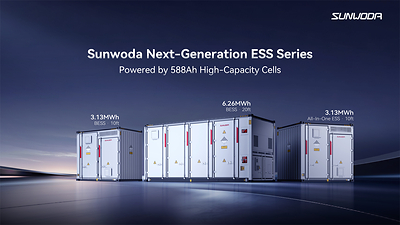
Launch of Next-Generation 588Ah-Based ESS
The new portfolio includes a 20-foot 6.26MWh Liquid Cooling BESS, a 10-foot 3.13MWh Liquid Cooling BESS, and a 10-foot 3.13MWh All-in-One Liquid Cooling ESS, providing flexible options for different capacities and deployment requirements.
As the flagship product of the series, the 6.26MWh BESS achieves a 24.8% increase in volumetric energy density, a 17% reduction in station footprint, and a 40% reduction in total system components compared to Sunwoda's previous generation.
The platform features a multi-layer safety architecture and hierarchical electrical protection design to enhance fault isolation and system stability. An innovative liquid-cooling and airflow coordination system ensures uniform thermal distribution, while a cluster-level BMS enables active balancing. The system supports centralized and string PCS configurations and is compatible with 2-hour and 4-hour applications, enabling flexible deployment across a wide range of utility-scale projects.
Complementing the flagship system, the 10-foot 3.13MWh BESS provides a compact and flexible option for projects with complex transportation, installation, or site-layout requirements. The 3.13MWh All-In-One ESS further integrates factory-preconfigured AC/DC architectures, reducing on-site integration work and enabling faster installation and commissioning.
Advancing Safety and Compliance Milestones
During the event, Sunwoda received certificates from CSA Group confirming that its 5MWh BESS platform successfully completed large-scale fire testing in accordance with ANSI/CAN/UL 9540A:2026 and was evaluated against CSA/ANSI C800:2025 requirements, further validating Sunwoda's system-level safety.
Sunwoda's 261kWh ESS series also received certification from TÜV Rheinland under Regulation (EU) 2023/1542, confirming compliance with applicable requirements for battery lifecycle management, material traceability, and digital battery passport readiness. These regulatory validations are being extended across its broader portfolio, further enhancing Sunwoda's readiness for the European energy storage market.
Enhancing Global Presence and Localization
The launch of the 588Ah-based ESS platform, together with the latest safety and EU compliance milestones, represents an important step forward for Sunwoda. By combining advanced engineering, system-level safety design, and international compliance capabilities, Sunwoda is strengthening its European localization framework and after-sales technical support capabilities to support local energy storage deployment and the global energy transition.
About Sunwoda
Sunwoda (Stock Code: 300207) is a global lithium-ion battery manufacturer with nearly 30 years of expertise. Leveraging its end-to-end capabilities covering cells, modules, BMS, system integration, testing, and recycling, Sunwoda has built a comprehensive product portfolio that includes battery cells, battery packs, containerized ESS, cabinet-based solutions, and mobile ESS, with solutions covering C&I energy storage, utility energy storage, mobile energy storage, rail transit, and green mining scenarios. Sunwoda is recognized as a BloombergNEF Tier 1 energy storage manufacturer and is listed in the BloombergNEF Bankability Survey 2024.
Contact:
Hellen Zhong
Zhongmeiqing@sunwoda.com
 View original content to download multimedia:https://www.prnewswire.co.uk/news-releases/sunwoda-launches-next-generation-588ah-based-ess-platform-at-ees-europe-2026-and-announces-safety-and-eu-compliance-milestones-302810975.html