Shield AI and Destinus demonstrate autonomous strike and teaming capabilities on an interceptor system in full-mission flight exercise
PARIS, June 15, 2026 /PRNewswire/ -- Shield AI and Destinus have successfully demonstrated autonomous collaborative strike capabilities on the Destinus Hornet, an interceptor system designed for counter-UAS missions against loitering munitions, drone swarms, and hostile uncrewed threats at scale. The tests, conducted in Segovia, Spain, validated Shield AI's Hivemind AI piloting abilities to support autonomy-enabled coordination and in-flight adaptation in contested airspace and demonstrated how this capability can help operators respond more quickly to large-scale unmanned threats.
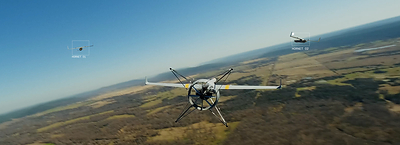
The milestone builds on two prior phases of integration: Phase 1 established Hivemind platform control on the Hornet in under two months and Phase 2 demonstrated V-BAT and Hornet multi-platform teaming in flight. For this phase, the Segovia campaign executed a complete operational concept developed for the Destinus Ruta, a low-cost turbojet strike platform designed for terrain-following penetration in GNSS-denied and contested environments. Hornet served as the initial integration baseline across the Destinus family due to a shared flight control architecture. This is intended to accelerate Hivemind integration across additional Destinus systems and reduce the technical risk ahead of the planned transition to Ruta.
"Autonomous systems must be able to sense threats, adapt, and act at the edge — especially in contested environments where direct command and control is degraded or denied," said Christian Gutierrez, senior vice president of Hivemind at Shield AI. "What we demonstrated in Segovia is a repeatable, fieldable autonomous capability that closes the reconnaissance-to-strike loop at the speed the threat demands."
Phase 3 exercised the full mission sequence aligned to the Ruta operational concept, including autonomy-assisted mission planning via ground control station, radio testing, autonomous terrain following, in-flight target updates, and autonomous terminal maneuver execution on operator command. The next phase will transition these capabilities to the Destinus Ruta platform in Ukraine, enabling coordinated strike behaviors between V-BAT and multiple Ruta systems. This follow-on evaluation will focus on repeatability, reliability, and integration with existing operator command-and-control architectures.
"Destinus platforms operate on our own flight control architecture, and Hivemind validated that we can integrate third-party autonomy without surrendering system design authority," said Tim Moser, chief technology officer at Destinus. "Repeatable integration, clear command authority, fieldable capability — that is how autonomy moves from a demonstration to something operators can rely on in the field."
The Destinus Hornet is a multi-role autonomous platform capable of counter-UAS, strike, reconnaissance, data relay, and security operations. Hornet systems form part of a broader layered air-defense architecture designed to protect high-value sites and critical infrastructure.
The Hivemind AI pilot enables platforms to sense, decide, and act independently, within operator-defined parameters under established command authority. Unlike traditional autopilots that cannot deviate from preplanned routes, Hivemind dynamically reroutes mission plans, responds to unexpected conditions, avoids obstacles, and executes complex tasks safely and effectively.
Shield AI will be exhibiting at Eurosatory in Hall 5A, stand A276, and Destinus will also be exhibiting in Hall 4, stand E255.
About Shield AI:
Founded in 2015, Shield AI is a venture-backed defense-tech company with the mission of protecting service members and civilians with intelligent systems. Its products include Hivemind autonomy software and V-BAT and X-BAT aircraft. With offices and facilities across the U.S., Europe, the Middle East, and Asia-Pacific, Shield AI's technology actively supports operations worldwide. For more information, visit www.shield.ai. Follow Shield AI on LinkedIn, X, Instagram, and YouTube.
Media contact:
Charles Forrester, Communications Manager (Europe): media@shield.ai
About Destinus:
Destinus is a European defence and aerospace company built for the age of mass-produced threats. The company designs and manufactures autonomous strike systems and air defence systems in Europe for European and allied armed forces. Its edge is the combination of a unified autonomy stack, deep vertical integration, and industrial-scale production that turns fast iteration into fielded capability.
Media contact:
FTI Consulting: destinus@fticonsulting.com

 View original content to download multimedia:https://www.prnewswire.co.uk/news-releases/shield-ai-and-destinus-demonstrate-autonomous-strike-and-teaming-capabilities-on-an-interceptor-system-in-full-mission-flight-exercise-302799762.html