New Beko research reveals eight in ten fans miss key sporting moments as matchday
Summer sport is turning the kitchen into the heart of home hosting, with fridges, ovens and freezers helping to prep food and drinks while guests stay focused on the game.
ISTANBUL, July 6, 2026 /PRNewswire/ -- Beko, Europe's leading home appliances company, has announced a new study showing that as more fans gather at home to watch live sport, appliances are doing the heavy lifting behind the scenes. From kick-off to clean up, the right appliances make hosting feel easier, less stressful and more enjoyable.
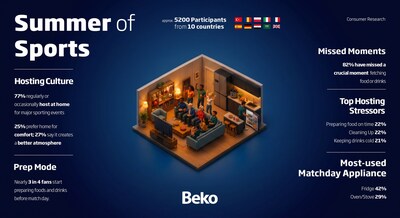
The study found that 77% of fans across 10 markets* regularly or occasionally watch sport at home, drawn by the comfort and atmosphere of hosting friends and family in their own space. But there is a generational divide; younger fans are more than twice as likely to make watching sport at home a regular social event. 44% of 25-34-year-olds say they regularly host, compared to 21% of those aged over 55. The research highlights the pressure this puts on the kitchen, with 82% of fans having missed a crucial sporting moment while grabbing food or drinks for guests.
Missing the key moments
While home may now be the preferred place to watch for many, hosting does not come without its challenges. The research shows that preparing food on time and cleaning up afterwards are joint top kitchen pressures during sporting events, both cited by 22% of respondents. Keeping drinks cold follows closely behind at 21%, while 17% say finding enough fridge space adds to the pressure and 16% struggle with cooking multiple things at once.
Together, the findings highlight how kitchen duties can pull hosts away from the action, turning what should be a shared sporting moment into a balancing act between keeping guests happy and keeping up with the game.
The kitchen MVP
Refrigerators are earning Player of the Match status on gamedays, with 42% of fans naming them as their most-used appliance when hosting. And yet hosts rely heavily on workarounds to keep drinks cold with 27% having rearranged fridge space to squeeze everything in. In addition, more than half (51%) say they have put drinks in the freezer to chill them faster. Ovens and stoves ranked as the second most used appliances at 29%, showing that food preparation remains a key part of the at-home matchday experience.
Planning starts before kick-off
With more sporting events bringing people together at home, nearly three quarters of fans say they begin preparing either days before or on the morning of an event. The findings suggest that matchday entertaining is becoming more planned and deliberate, highlighting the growing role appliances play before guests even arrive. From making sure there is enough fridge space to chilling drinks in time and preparing food with less last-minute pressure, appliances help hosts get organised earlier and feel more in control when the game begins.
"Home has become the preferred venue for major sporting events. Our research shows that fans want to spend less time managing food and drinks and more time enjoying the match with their guests," says Ragıp Balcıoğlu, Global Chief Marketing and Strategy Officer at Beko. "That's exactly where intelligent appliances can make a difference. Beko's AI Adaptive Cool technology learns household usage patterns and automatically optimises cooling, helping keep food fresh and beverages ready throughout the event whilst saving energy."
Key findings:
- 77% of fans globally say they host friends or family at home regularly or occasionally to watch major sporting events.
- 44% of 25–34-year-olds regularly invite friends or family round, compared to 21% of those aged 55+.
- 25% say watching at home is more comfortable, while 27% say it creates a better atmosphere.
- 82% have missed a crucial sporting moment because they went to get food or drinks.
- Preparing food on time is the biggest source of kitchen stress globally at 22%, followed by cleaning up afterwards at 22% and keeping drinks cold at 21%.
- Refrigerators are the most-used appliance during matchday hosting globally at 42%, ahead of ovens and stoves at 29%.
- Nearly three quarters of fans globally say they start preparing food and drinks either days before or on the morning of an event.
*JL Partners polled 5,139 people from ten markets: UK, France, Spain, Italy, Germany, Romania, Poland, Turkey, Egypt and Saudi Arabia.
ABOUT BEKO
Beko is an international home appliance company with a strong global presence, operating through subsidiaries in more than 55 countries with a workforce of around 45,000 employees and production facilities spanning multiple regions—including Europe, Asia, Africa, and the Middle East. Beko has 22 brands owned or used with a limited license (Arçelik, Beko, Whirlpool*, Grundig, Hotpoint, Arctic, Ariston*, Leisure, Indesit, Blomberg, Defy, Dawlance, Hitachi*, Voltas Beko, Singer*, ElektraBregenz, Flavel, Bauknecht, Privileg, Altus, Ignis, Polar). Beko is the largest white goods company in Europe with its market share (based on volumes) and reached a consolidated turnover of 10.7 billion Euros in 2025. Beko's 28 R&D and Design Centers & Offices across the globe are home to over 2,000 R&D employees and hold more than 4,500 international registered patent applications to date. The company has achieved the highest score in the S&P Global Corporate Sustainability Assessment (CSA) in the DHP Household Durables industry for the seventh consecutive year (based on the results dated 16 October 2025).** The company has been recognized as the 89th most sustainable company on TIME Magazine and Statista's 2026 list of the World's Most Sustainable Companies and has been the sector leader for three consecutive years. Beko's vision is 'Respecting the World, Respected Worldwide.'
*Licensee limited to certain jurisdictions.
**The data presented belongs to Arçelik A.Ş., a parent company of Beko.

 View original content to download multimedia:https://www.prnewswire.co.uk/news-releases/new-beko-research-reveals-eight-in-ten-fans-miss-key-sporting-moments-as-matchday-302817732.html